Tuesday, May 28, 2013

May 24

  
Nitrate and Ammonia line graph!
 (Catie and I had the same fish tank)

May 23


The changes, slowly but surely, were definitely for the better.  We didn't start our very well with pretty high ammonia and nitrate.  Our plants that we added really grew a lot over time and grew new stems or leaves just by over night sometimes!  So we went from 0 plants to 3!  I remember when we started out, our water was never clear.  That tank, I figured, was not used as much as the others so the rocks were very dirty and when we sifted through the rocks in the beginning over and over the tank still turned out dirty when we put the water in.  On this date however you would see our tank as clean a crystal because we did a full water change and siphoned it every week!  Even with the hard work overall ten fish did die.  Technically though, it wasn't really our fault.  We took pretty good care of them, but most died from the filter being to strong (killing two of our fish), Mrs. Wood giving me the bacteria instead of the dechlorinator (four fish died), and the rest died from stress from when we got them, to putting them in the tank.  


May 22


I have learned a lot from our aquarium project!  I would say that I've never even knew how hard it was to keep a fish maintained and totally underestimated how much it takes to keep the ecosystem of your tank under control. 1.) You have to do ammonia, nitrate, dissolved oxygen, pH, and Alkalinity tests to make sure the environment is stable enough for your fish to survive in.   2.) I learned that tap water can kill your fish and that you must use declorinator and bacteria when adding fish or your fish could die! (don't get those two mixed around though, that could be bad!:P) 
3.)  Fish must have oxygen.  I had no idea that we needed a bubbler to keep our fish alive but now I do. 4.) Different fish do not get along with each other whereas I thought every fish would be fine and playful. (one of our fish lost an eye in the beginning because others didn't like him- even though those we picked were supposed to "get along"). 5.)  Different fish act differently and like other places of the tank and tend to stay or swim in that area.

I would change this project for next year by letting everyone know that a filter can be bad for small fish.  We put a filter in our tank and it killed two of our fish because it was too strong and sucked them up:( I would also change how we learned how to take care of them after we got them.  Going into it we were really confused on what to do at first and what it took to help them survive haha.  The guys at pets mart said only certain fish could live at certain temperatures and some fish had to be in groups and most fish you added wouldn't survive if you added more than five fish or such. We went to pet co first and didn't learn this until later. In our group we had three people and that was difficult because some people wanted different fish, but some fish needed to stay with a certain group.  Overall though it was pretty fun! It was also very sad though! I did not want to lose so many fishies:(

May 21


 Our aquarium was going pretty good on this date!  Our temperature was fine and was around 76 degrees Fahrenheit and 25 degrees Celcius.  We added another plant to bring our nitrate down because it was too high(10).  But our ammonia was very good at 0!  This means that we were taking good care of our tank and the ammonia level means the siphoning and water change paid off!  For observations I wrote down that Catie's fish was actually skinnier it looked like and one of our shrimp went missing!  We never did find his body or anything so it's a mystery. (I don't remember Mrs. Wind saying that shrimp jumping a tank was possible but who knows haha).  But overall, not bad!


May 20


The Autumn Olive(emergent) is 20 feet in height.  Leaves are dark green and untoothed.  The underside is covered with silver-white scales.  The flowers are light and yellow and are borne along twigs after the leaves have appeared early in the growing season. Due to the nitrogen-fixing capabilities it has the capacity to adversely affect the nitrogen cycle of native communities that may depend on infertile soils.


The Oxygen Weed has numerous threadlike roots, which are adventitious (branching from the stem) and, along with rhizomes (horizontal stems in the sediment), anchor it to the bottom.  This plant grows supper fast and takes up most of the oxygen for fish and hurts the ecosystem.


Duckweed is a free floating plant that has individual fronds that produce fine roots.  Mature fronds appear 1.5 to 2 times longer than wide, with widths measuring from 1-3 or five mm. Fronds are narrowly egg-shaped to slightly kidney-shaped and intensely green in color. As a problem it can become a serious nuisance due to its rapid colonization, easy distribution and quick dispersal rate.


These invasive plants are more troublesome than it's natural home because people aren't accustomed to them in different areas whereas where they used to be, people developed different ways to lessen or get rid of them.

May 17


Our water quality throughout has been pretty good!  Overall we've taken very good care of them.  Some issues we had was when it got dirty we siphoned it and one time we did a full water change when four of our fish died. This was because our tests were kinda bad at first but we did succeed to get it to a normal level. Most of our fish died because Mrs. Wood gave us the wrong bottle on accident. It was supposed to be the dechlorinator but she gave us the bacteria instead!  So that showed us how important the water quality test is and to keep our tank well maintained.  After that there was a point our Nitrate was too low so we had to steal plants from anothter tank to keep it balanced.  Sadly, right when our tank was at the normal level and perfect we had to take them all home or give them away): However, we learned so much about different algae and polution, about nitrate and ammonia, dissolved oxygen, and the pH of the water during this interesting project!


Wednesday, May 22, 2013

5/16/13

This day we did not do a water quality test, we did power point presentations.  But what we did do was a complete water change and clean the rocks of our tank because our fish died and we got even more fish.  We did not want to lose another fish ever again!   Our fish freaked out when we put them in a different container with the volcano as the bubbler, but it was for the best! The different fish we got was a guppy, a snake like fish, and two ghost shrimp.  Our snail, Gary, once we put him back in, went into shock.  Apparently the water change was to much for him and he had died the next day.  We all literally work so hard so please give us a good grade.  We do not kill our animals on purpose!  We added this big rock looking thing for the fish to swim in between and the two Platties that we have, when we put them back in, swim next to each other always and were never someplace without the other.


This is the snake looking fish, he is on the wall of it.


4/15/13

An ecosystem that is self-sustaining means that it is able to adapt and take car of itself, sort of like how a plant doesn't need fed and can make its own food.  This term does not describe our aquarium in many different ways.  First, the ecosystem of our aquarium would falter and become unhealthy if we didn't test the water for ammonia, nitrate and pH.  So then we would know whether to change out the water, add more plants, add dechlorinator, etc.  Second, our fish are not available to outside resources so we need to feed them ourselves or else they would die.  In order for our ecosystem to become independent, we would have to set up timed tests that would happen automatically and timed feeding or put them in a lake or someplace where they'd do everything themselves.

5/14/13


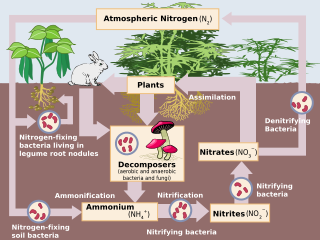
The nitrogen cycle is the process where nitrogen goes through chemical changes. This transformation can be carried out through both biological and physical processes. The processes in the nitrogen cycle include fixationammonificationnitrification, and denitrificationWhen plants and animals die, bacteria convert nitrogen nutrients back into ammonia salts and ammonia. The step of Fixation includes bacteria conversion that is necessary to convert gaseous nitrogen into forms usable by living organisms, which makes nitrogen a crucial component of food production.   It is not possible to not include plants, animals or bacteria because if they're wasn't any of these, the cycle couldn't go onto the next step.

5/13/12

Our water quality consisted of our ammonia being zero, our nitrate being 5.0, the pH was 8.4 and it was 76 degrees Fahrenheit.  This would probably compare to a lake with a lake being higher in both ammonia and nitrate because there is lot more fish that go and more plants.  In a river it would vary because the ammonia probably get swept away. So the water quality in the river would probably be better but not as much as in an aquarium because humans can control the balance in that situation but not in natural lakes or rivers.

Monday, May 13, 2013

4/30/13

Aquarium Update
Our aquarium is doing pretty well! We did our Ammonia and Nitrate test and the Nitrate was 5.0 and our ammonia was .25 which is pretty darn good!  The ammonia is the amount of pee or poop is in the tank and so we've brought it down from 1.0 to finally to a good level! The temperature was 71 degrees Fahrenheit and we did not do a water change I don't think... We observed that the Red Platty and the Mickie mouse fish poop a lot so it was surprising to see our ammonia so low.  The two plants are also growing very well.

  My fish is the back one, Catie's is the one nearest to the plug and the Glow Fish is the yellow one (which is Baileys.)

5/10/13

Well since this is a late update I might as well inform that four fish have died.  Mrs. Wood gave me the bacteria instead of the dechlorinator when I siphoned our tank (which we're supposed to be doing everyday) , and fish cannot survive without the dechlorinator and since we aren't checking the tanks over the weekend, we didn't have a chance to figure out that I put in bacteria.  It's just very frustrating because we have had at least ten fish die already and we do everything we're told but I guess it's just bad luck.  We don't purposefully kill our fish I promise. Anyway our last quality check was very good (before the dechlorinator incident), our Nitrate was 5.0, ammonia was 0, temperature was 74 degrees.  So everything checks out pretty well the ammonia can be bad for the fish if it was too high so that's good, Nitrate should be about 5 too.  So this proves we are taking care of our fish! We did the water change about two days after the test because the floor of the tank was filthy.  I still feel awful about our fish dying but I guess accidents happen.


R.I.P. The three Glow Fish. :( and my Neon Tetra

Sunday, May 12, 2013

5/9/13

To use a dichotomous key you have to go through a series of numbered statements that describe a certain type of algae or anything really.  Then once you find all the ones that the numbers match, that's what you're looking for. (hard to explain)   For each number there is a choice like a.) colorless....2 or b.) colored.....6.
Then you go to the number for whatever is a true characteristic on what you're observing (we observed algae for example).  You keep on matching the statements with what you observe until you come up with a name of what it is in the end, telling you what your item is called.  The purpose of this is to learn the different characteristics of what you're trying to classify and how they are all unique from the others or similar.  When making our dichotomous key in class, we looked at how some algaes were similar and different.  The problems we ran into were trying to find something that would apply for one algae and not the others and coming up with different characteristics that were not on the chart.


5/8/13


Assessing Water Quality

To asses the water quality of a body of water, there are some steps you would need to take.  First, you would observe the water and judge if it looked polluted or if it had an algae bloom for example.  Next take a sample of the water and see if it has any algae.  The different kinds of algae you find may show if it is healthy or unhealthy water.  Thirdly, test the temperature, ammonia levels, dissolved oxygen, nitrate levels, and pH.  After that if you wanted you could run different types of chemical tests on the water also.  It is important to do all these steps in order because I'm assuming to run all of these tests would cost you a lot of money!  If you observed that the water was unhealthy first and was dirty with pollution you were probably right!  Or algae blooms are easy to spot too!  If that's not good enough you can take a water sample and observe it underneath a microscope you can find different types of algae. Some are more resistant to pollution such as Anabaena, which would mean it would be poor quality water.  If you found Stigeoclonium (which helps clean the water) it's more likely to be a healthier quality body of water.
  

5/7/13


Dissolved Oxygen and Carbon Cycle.

Two sources of dissolved oxygen would be the oxygen from the plants in the water and the oxygen and its contact with the atmosphere.  During the day the oxygen levels rise (because photosynthesis occurs with sunlight) and the carbon dioxide levels decrease as the plants absorb it.  During the night carbon dioxide increases while oxygen decreases.  This is because their is no sunlight to create photosynthesis, and therefore oxygen. However, the plants instead of producing oxygen, absorb it and produce carbon dioxide.

Saturday, May 11, 2013

5/6/13

Dissolved Oxygen
The term "dissolved oxygen" means the amount of oxygen dissolve in a body of water as an indication of the degree of health of the water and its ability to support a balanced ecosystem. The oxygen comes from plants in the water and also contact with the atmosphere as well.
Steps to do a dissolved oxygen test:
1.) Put water filled to 25 mL into a container.
2.) Get tube with a sort of yellow water and place it in the sample.
3.) Then break off the tip of it.
4.) Let it sit in the water for a few seconds.
5.) After you removed it place your finger on the removed tip and turn it upside down over and over.
6.) After mixing it up let it sit for about 2 minutes.
7.) Compare results with the chart.

Our results showed about 9 mL which is good because if the oxygen was less than 3 mg/l it would not support the fish. In a small pond it would probably hold more oxygen than in an aquarium because there would be more plants.  A large river would have probably the most dissolved oxygen because a fast current allows more oxygen than a lotic system such as a pond.  A pond would also probably be warmer which warm water holds less oxygen.


5/3/13

Aquacheck!
The Aquacheck has five components which are free chlorine, total chlorine, total alkalitnity, total hardness and pH.  Free chlorine refers to the ions that are free in the water, total chlorine is the combination of free and combined chlorine, the buffering capacity of water is total alkalinity (or resistance to pH), total hardness is dissolved minerals in the water, and pH is how basic or acidic the water is.  It can range from 0-14, zero being most acidic, 14 as basic, or 7 as neutral.  These checks are important to know the quality of an aquatic environment.
Our aquacheck turned out pretty well! Our free chlorine was zero as well as total chlorine.  The total hardness was 425, the total alkalinity was 240 and the pH was 8.4.  The pH levels are great because a pH of 3 kills the fish and ours was way high than that. The pH should range from 6-8. Our free chlorine and total chlorine is great that it's zero because chlorine can kill the fish. The hardness is good because they need hard water to survive.  The alkalinity relates to the pH and is okay for the fish but is not the best the best would be maybe around 350 (I think Mrs. Wood said but it's hard to remember). However our tank seems to be a pretty healthy environment so far!

prgrsvimghttp://ts1.mm.bing.net/th?id=H.4647902965991644&w=80&h=80&c=8&pid=3.1&qlt=90

]

5/2/13

Our fish are a variety of different species.  Mine are the Neon Tetra and the Red Wag platy  Catie has the Mickie Mouse fish and Bailey has the three Glow Fish and a snail.

My fish info.

The Neon Tetra is a pelagic freshwater fish native to trapical parts of South America and orginates from Brazil, South America, and eastern Peru and can also be found in the River Amazon, Tiger, and Napo and Yarapa. It has a spindle shaped body and a blunt nose and a neon blue line that runs on either side of the body with a red line doing the same only placed on the middle of the body down to it's fin.  If the neon blue stripe dulls or looks dim in the light, that may mean your it is ill or stressed. Over 1.5 million Tetras are imported into the U.S. alone, each month!
1. Soft acidic water is the best condition for this fish.
2. The neon tetra is not easy to keep alive because it can develop an incurable Pleistophora disease. 
3. These are omnivores and can eat algae and can eat things such as freeze-dried blood worms too.
4. Our Neon Tetra is normally more comfortable in a group of its own kind but the other ones we had died.
5. It has no eye on one side of it's head and we believe it got into a fight.
6. Can grow up to 1.5 inches.
7. Preferred temperatures from 73 to 79 degrees F.
8. I observed that he stays very close to the front glass.
9. He doesn't play with the other fish or chase anyone.
10. A light over the tank is required so they can see their food clearly.

The Red Wag Platy is a solid red with black tipped fins and black lips.  At first when born the Platy does not have black tipped fins, it's more of a yellow, but when they get older the black fills in. He originates from Eastern Mexico, Guatemala and Northern Honduras.
Requirements/Behavior
1. Platies should have plenty of plants in their environment.
2. A good filtration system is needed for these fish.
3. These fish are omnivores and need algae to feed on.
4. You should change the water 20 to 25% every week.
5. They can live with any other peaceful community fish (like the ones we already have)
6. The male we have can reach up to 1.5 inches.
7. I observed that it swims very slowly and not as fast as the others.
8. I also observed that it gets along with the Mickie Mouse Platy more than any other fish.
9. He goes a lot.
10. He moves very fast when food is in the picture and has a big appetite.

5/1/13

Aquatic Science Field Trip!
My field trip experience was awesome!  I was really glad that my friend Victoria was able to come too because she really wanted too but her teacher wouldn't let her go on the bus when the announcement was made.  But she got a ride there and it turned out well! It was a lot of fun and we got to see many different animals and fish.  The most interesting thing that I saw was the Sea Manatee.  It was a ton bigger than I thought it would be and it was really cool to see one as it swam by.  I learned that the tree kangaroo that we saw was endangered, the burrowing owl really has three different calls and doesn't hoot, the Giant River Otter has adapted webbed feet and a narrow body for swimming against currents, the yellow-banded poison dart frog resides in Venezuela, Guyana, and South America, lastly the Manatee is endangered and need air but can stay underwater for up to twenty minutes. I would have liked to have stayed longer because I missed the Moon Jellyfish and the other animals in the dark room.


4/29/13

                                                                  Pollution Index Chart
The purpose of the Pollution Index Chart helps to tell how clean and healthy the environment is due to the amount of algae. If you do the math which is the number of algae you find divided by five, then only using the a whole number it can divide into multiplied by the number on the pollution index chart, you can figure how polluted the water is. The benefits is you can tell how clean and healthy the environment is, a negative would be is that you're only sampling a portion of the area so the results might not be very accurate.  If the numbers that you get from the math are lower than 14 than the pollution is low. If the numbers are 15-19 than the pollution is probable. Lastly, if the number you get is greater than 20 than the pollution is high.  If the diversity of algae is low but the population of a certain algae is high the water is polluted. If the diversity of algae is is high but the population is low than the environment is healthier and clean.